Monday, March 15, 2010

Look who is coming to dinner

In my last post, Like planning a flash mob, I was talking about the complexities of planning an upcoming professional learning opportunity. I will have that "opportunity" tomorrow and I am excited about it. I was very nervous we'd only have a few people, but we are over 30 now, and I have had to add spaces to present.

The day, which is about 21st Century Literacy, has attracted a pretty wide group of teachers, most of whom will be presenting about what they are doing this year. It is designed to be a conversation between professional learners about what they are trying and how it is going. Some of those coming will present for an hour, some for a half hour. I like the fact that some will talk about co-teaching experiences as well.

We are going to have a very diverse group of people who are coming to share what they have been doing to meet student needs. They are sharing their learning along 1 or 2 of the themes of the day: assessment for learning, struggling readers, learner engagement, differentiation, and digital learners. Here is a look at who will be there.
  • READ teachers - teachers who work with reluctant or even no-readers on acquiring literacy skills. These teachers are a part of our division's priority of Literacy for Life.
  • EAL teachers - teachers whose students speak English as a second or additional language. These teachers are working on language acquisition in addition to literacy skills.
  • Pod and Grant teachers - teachers who have been given different or additional technologies to meet a specific instructional need. In the case of the grant teachers, presenting about their action-research is a required part of the grant process.
  • Secondary teacher-librarians - are teachers who manage our learning resource centers/libraries, and work with teachers and students to support learning. Our TLs are typically full-time in the library. This year our TLs have been working on creating a digital presence for our libraries.
  • SITLs - some of our Secondary Instructional Technology leaders will be present. They work with teachers in individual collegiates through planning, instructional and technical support. Almost all collegiates have an SITL, some of which have release time to work with teachers.
  • Classroom teachers - a number of classroom teachers, particularly English/Language Arts teachers are coming to present what they have been trying in their classrooms.

Throughout the course of tomorrow and the next day, some teachers and our professional development team will be documenting their experiences learning. I'll be posting on this blog, others will capture video, build digital stories and use other web 2.0 tool. Expect to hear a lot from us.

Thursday, March 4, 2010

Like planning a flash mob

One of the members of our board gave me the idea for a new kind of learning experience I am helping co-plan next week. It reminds me a bit of trying to plan a flash mob.

The session is about 21st century literacy, and has some elements of formal presentation. However the bulk of it is teachers talking to other teachers. Each participant comes and talks about a technology or idea they have tried in their classroom. These short sessions are a combination of professional sharing and discussion.

In the next week I will start to get confirmation of who is coming and what they will be talking about. So far, I only have 4 confirmations. Teachers seem pretty nervous about the sharing part, I think because they feel they need to be experts. I am getting worried that we'll be a mighty small group.

One of the other things we are doing is having some teachers document what they are learning as they are learning it. Again, I am a little unsure how it will turn out. Yesterday, I was in a PD session with a teacher who was talking about planning a flash mob as an arts education project with her students. You can watch the project on YouTube.

We watched their "performance" and she talked about the nervousness of doing something with only Facebook to promote it. She also found it difficult to get permission from the malls they wanted preform at. It's feeling a bit that way for me.

The day is set to go for the 16th, and day where we'll be putting together and posting what we learned is the 17th. I'll post then about our flash in the pan of a day. I'm hoping it will distill to something delicious rather than fail to ignite.

Tuesday, March 2, 2010

Blogs are scary

I think I might have scared others today. I was working with a group of teachers who were kind enough to want to learn about some tools to use in presentation. Then I hit them with the blogging part and they stopped making eye contact.

When I set up this blog, I invited the others on my team to help with the blog. Dave did a post on collaboration, and Judy keeps both a professional site and a professional blog with Jenn. But for all us, blogging remains more than a more little scary. Here is an eloquently worded one of my colleagues concerns:
Blogging is scary because you are putting your thoughts for all to see - cemented for as long as the Internet is out there. It feels as if you can't retract, and it is set stone.
The others concerns are just as real. Blogging could cause you to loose control of what is up "out there", or others could say something you don't want. You might upset people. Blogging is a commitment, and once you start you need to continue.

I have observed an interesting related phenomenon. Very few of the people who know me and read this blog post to it. Teachers are lurkers as a group. They often send me emails about something I blogged (I got three emails yesterday), but a public conversations is just a little too. . . you know. . .

public.
Yup, that's the issue alright. Because even in an learning institution like a school division, too many public statements are probably not a good thing.

I have enjoyed seeing the offerings of other groups of consultants throughout the province, and think it is great to see which subjects they cover, and how they are responding to new curricula or what they value based on what they blog. But there are all those problems of public commitments when things may change, being perceived as the public voice of the division when you are an individual who is learning - it is all just so


public.

What do you think? (Yes, I am aware of the irony of asking).

P. S. I just started reading my RSS feeds and come up with an interview with a consummate teacher blogger - tangential, but interesting.

Wednesday, February 24, 2010

Why we want students on Youtube

When we changed filtering policy, lots of people have been asking why we want to give students access to social networking site. They are worried that students will be off task, post dumb things on line or endanger themselves. What could possibly be worth these risks?

1. Students are already on social networking sites and they are already creating digital footprints. We need to teach them to create footprints that really show their strengths. If they can access Facebook, we can teach them how to protect their privacy. Teaching media literacy is critical responsibility for the modern teacher.

2. If students are bored and want to be using technology, the logical solution is to use the technology to promote learning not attempt to prevent them from accessing it. Technology is intimately connected with choice, which increases both motivation and potency.

3. Think about AFL classrooms. These are classrooms where students use products, conversations and observations as evidence of their learning. What holds evidence over time, shares it with authentic audience and provides opportunity for many iterations of feedback? Web 2.0 (no cape or tights or speeding bullets are needed).
4. There isn't much evidence that many students are lured or tracked more often virtually. Research says they are much more likely to be the targets of in person predators. The place where they are most often hurt online? Cyber-bullying. What does the research say can prevent it? Open dialogue in schools using social networking and cell phone examples.
In the end, we need to think about what our goal is for our high school students. I think it is education - give them the tools to learn, make good choices and represent themselves well. That means they need access and we have to teach them to use it responsibly.

Friday, February 19, 2010

Technology and AFL - signs of change

Today I was working with a group of secondary instructional technology leaders, secondary teacher librarians and learning leaders. We were discussing the connections between assessment for learning (afl) and technology. And as we discussed, we talked at lot about the challenges of both afl and technology as change. Take a look at the backchannel from our morning to see some of our discussion.

As I was reflecting on the challenges that this group faces in trying to support teachers, I was reminded of a graphic a teacher friend sent me last week. (I wasn't able to backtrack it fully to site it properly - if anyone finds correct attribution, I'd like to know. This wiki is the earliest use I could find.)

Change, particularly transformative change, is a very difficult thing in education. Because I work in technology and professional learning, virtually everything I read is focused on how to create change in one way or another. I liked this graphic because it really summarizes how gaps create barriers to the change process. It also helps me to think about why many of the teacher leaders I work with feel frustrated.

Technology requires both pedagogical and structural change that never really stops. Software, hardware, filtering, and policy must adjust as new technologies are available, and many people need to be a part of the process of deciding to change. Most of the time, those people aren't teachers, but they hold the keys to the resources that teachers need to make the change. Teachers fall into loops of frustration and treadmill because they can't access the resources or there isn't an effective plan for action, and teacher leaders are sandwiched between the angry teachers and the needs of students. Trapped by the inexorable slowness of institutional evolution and pressure from teachers and students who want change, teacher leaders can sometimes feel powerless.

At the same time, we teachers are often the source of our own confusion, anxiety and resistance when we don't want to use technology. Sometimes we can't envision why a technology is worth using and feel it is pushed on us. We often feel that our skills sets aren't as good as they should be, or as good as our students, so we feel heavy anxiety and say we "don't do computers." We are also busy people and don't want another thing to do - and while extrinsic incentives may cause us to use technology in the classroom, only a deep belief in student centered learning will cause us to use it well.

Back to frustration for teacher leaders, who are swished between desires of the converted and the slow pace of change, then pressed from above by the confusion, anxiety and resistance of those who don't want change at all.

Many divisions, including my own, have made tremendous progress in the last few years. I have seen us change filtering policy, put more money into professional learning on many subjects, and start to provide teachers with laptops. All of these things are correlated with better student outcomes and deeper student engagement. I know we are on the right track. So why are teacher-leaders frustrated, even as we are excited about the opportunities technology and afl offer for our students? I actually think it is a good sign. Stay with me here for a moment. . .

Take a look a the wallwisher exit slips from the end of the day. Many of these people want in, not out. That is a sign of people who believe in students, want to help teachers and can articulate what they need to do to gain more opportunities to influence how professional learning happens in their schools. I know frustration isn't always a sign of good things, but in this case I think it is a positive portent. If we can keep giving them resources and reducing the barriers, many of the teacher-leaders I worked with today will keep working until they can actually create significant change.

Monday, February 8, 2010

Real Choice

I was speaking to two teachers yesterday about real choice. I distinguished it from fake choice this way. When my children were 2 and 3, and in a phase where they really wanted to do and choose everything "self", I often provided the illusion of choice to gain compliance.

Me: Well, it is almost bedtime. Would you like to put on your pajamas first or brush your teeth first?

See? Looks like choice, but it isn't. You might get to choose your order of operations, but you are still in bed by 8 and your choices made no difference to the outcome. I think school functions on many of those algorithmic (finite sequence with instructions) choices.

Me: Today we are going to show we can suit what we write to our intended audience. Would you like to write a descriptive poem or a narrative poem?

Never mind that almost none of you see poetry as a way you choose to express yourselves and the intended audience will be me. I've given you choice - and it is about as genuine as the "Have a nice day" you get in a fast food drive through.

If you haven't read Daniel Pink's new book DRiVE: The surprising truth about what motivates us, you should. You can get the synopsis by watching his TED talk, but you miss some really important stuff.


In the book, Pink talks about our world has shifted from algorithmic tasks to heuristic ones. 70% of the new jobs created are heuristic and need people who can think creatively, plan their own task and solve problems. In short, the type of people who have experience choosing in complex situations without a template. Pink argues that schools need to shift to providing choice where ever possible, and that those choices need to be about things that are important. If we want students to be engaged, we need to avoid rewards and punishment and focus on creating opportunities for flow.

Dangerously Irrelevant, a blog I read, was on this very topic recently. The essential argument was that we let students choose content but not delivery, and they need to choose both. I think I'd take it a bit farther.
  1. We need to make the content essential questions, so it is worth studying and full of choice.
  2. Then we need to co-construct what is worth doing and how we can tell if it is done.
  3. Lastly, we need to allow students to show us what they know in a wide variety of ways (not just deliver it differently).

Let's try the classroom conversation again.

Me: When you write a text message or an essay, or you compose a digital story, you use different conventions. Let's view some pieces of text and talk about the differences (class discussion ensues).

Me: Make a list of three things that you think people need to hear. For each one, write what the message is, which people really need to hear it, and what type of writing, audio/video or speaking they will listen to the most. When you are done your list, pick the one that draws you the most (students start thinking about what they believe and how to communicate it).

Me: Now when someone really communicates well for an intended audience, how do you know? (Assessment for Learning process follow. The class brainstorms criteria. I help them group the criteria, prompt for criteria that might be missing and help them think about value the criteria in relation to each other).

Me: Now look at your plan. Will you be able to show us what you know? Get a buddy to help you revise it, so you can meet our criteria for communicating well for the intended audience (good critical thinking and an opportunity for powerful descriptive feedback before the product is even created).

In my newer version, virtually ever stage of the task is heuristic. My students are designers, arts and writers, and problem solvers. They are thinking critically and making choices about a subject that matters to them. In short, they are engaged because they are choosing and their choices really matter. They are motivated by the worthiness of what they choose not the mark they hope to get, and get much closer to mastery as a result (Pink has lots to say on this subject as well).

I don't have time to do this with every lesson, but I do it every time the thing my students are learning is important. And like with my children, I have taught my students about how to make effective choices and provided a safety net for the inevitable bad choices (if it isn't safe to fail, it isn't safe to take the risk of learning).

That's what real choices are, complex problems with significance - things that encourage engagement in deep learning rather than driving through on the way to a credit and a forgettable, nutrition-less meal.

Monday, February 1, 2010

Just like Parallel Play

Every time I think I need something, Wes Fryer finds it somewhere. I was working with teachers on social networking in the classroom last week. I showed them Clay Shirky's TED talk on social networking and had them categorize their own learning traits as digitally immigrant or native so they could think about providing digital learners opportunity to engage.


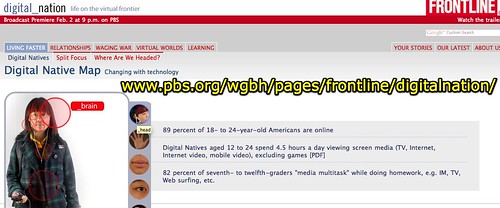
As we were doing it, I wished that I had a good interactive visual that provided facts on who our students are digitally. Today as I was checking my RSS feeds, Wes' blog Moving at the Speed of Creativity linked me to an interactive image full of interesting facts about digital learners.


I keep trying to persuade others that it is really worth their time to develop some form of on-line learning network. RSS is great for those who aren't really ready to talk to others yet and just want to lurk. In the workshop I lead on Friday, one of the teachers remarked that seeing teenagers in a circle texting each other is a lot like watching toddlers when they are at the parallel play stage. For me, watching others get information by searching but not use a digital PGN is the same thing. They are all playing near each other, but no one is playing or learning together. Anyway, thanks to Wes for being a great digital play-date and PBS for another great toy.