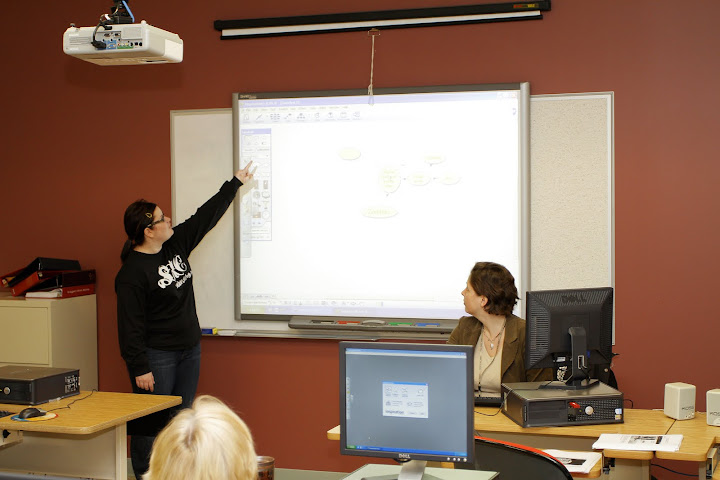
Sandra Mancusi and Joanne Molaro started off by explaining how they use Drop.io. Their whole session can be found there, and the login is student. They also created a prezi, which can be found in their list of links or viewed directly.
Sandra and Joanne applied for a tech grant last year from the division to create a language lab. They got a grant and picked up computers, speakers, a smart tablet and a data projector. They also attended ISTE in the summer of 2009 to prepare themselves to use the tools. I am excited about going to ISTE this summer, and their experiences make it sound like I will like it.
As the presentation started, getting the smart tablet and the smartboard working was an issue. However, they worked around technical issues, and showed a variety of tools they were using. I was reminded that we need just in time support available in our collegiates and at central office, so that when there are technical problems, they can be quickly solved.Sandra and Joanne are adept enough users that they can work around it, but many others are not.
The free web 2.0 tools they are using create a really rich set of expereinces for students. Sandra explained how using Glogster allows students to speak in Spanish, record their writing and personalize layouts. The ability to create, personalize and share is very well connected to 21st Century Literacies.
As Joanne was explaining her voicethread she did a great job of explaining how it helps English as an additional language learners. She created a presentation of Rememberance Day, and gave students a copy of the text. They pre-learned words, and uses the voicethread as a listenting activity. This allowed her students to listen and re-listen, to decode using the images and to prepared for the new cultural experiences. It also introduced students to Voicethread.
Voicethread is a good tool for assessment for learning, because you can leave oral or written comments on the digital story. Joanne created examples and the class discussed criteria. Then they created their digital story. As they were presenting, Sandra noted that audio visual examples help students process the content more effectively. Sandra and Joanne showed student voice threads and how to make comments on them.
Each time I see voicethread used, I think about how we want to teach students how to give specific, descriptive feedback. When Joanne's students presented their voicethreads, she had them explain what they chose and why, which helped with metacogintive skills. Since the project asked students to compare their orginal city with their lives now, there was a good chance to do critical thinking. Sandra noted that there is no real way to archive work for free. That is a problem if students are trying to develop portfolios and show their learning over time, whcih is critical to metacognition.
Sandra and Joanne showed a wide variety of tools, and it is worth your time to view the links at the top of this page. However the best thing about their session was what they spent a lot of time explainign why they did what they did and invited audience comment. If we do this kind of thing again, I think we should suggest more why and audience doing in general.
Tuesday, March 16, 2010

Teachers reflect on the last 20 years
As a part of our opening session, we had teachers think about the changes in a wide variety of areas compared to K-12 education. You can see the full powerpoint and the list of presentations.
The teachers worked in groups to comment on the changes they had seen in technology. At first they were instructed to make lists, then they made a sentence to capture the critical differences. We used Etherpad to write the comments.
If you haven't used Etherpad (or the identical Type with Me) before, the basic idea is that you can co-construct something at the same time. It is like Google wave but more limited. However, it has the advantage of being instant, with no login. Etherpad was in good form yesterday, but seems to be down as I am writing this.
With Etherpad/Typewith.me, you can create your own title, or let the application generate one for you. Next time, I'd make my own, as a the lowercase L and the capital I looked too similar and we wound up with two pads, here and here. Looking over the pads shows some interesting things about how this group of teachers, all of whom are trying to use technology in their classrooms, feel about the technical changes. Sometimes they are positive about the opportunities, but many times they are concerned. I think that the opening session reveals many of the challenges we face as teachers trying to embed technology in our teaching, including the pace of change and the challenges that our students present as digital learners.
I am not sure we really understand what digital learners mean - sometimes we think it means uses computers in an expert way. Our students aren't computer experts any more frequently than we are, they just prefer to take and use information differently. I wish we had more chance to discuss this.
After we looked at how banking, travel, books, movies, music etc. were all changed (think both the technology and the underlying way of interacting) in the last 20 years, we came to the slide of K-12 schools. It was the first example of silence, followed by a little whispering, clever comments and some laughs. It's hard for teachers to get to that visions of engaged digital learner to be a reality.
Audio comments avec Rolf's wry humour

I got to attend the second half of Rolf Polan's session on audio comments. Rolf is a Secondary Instructional Technology Leader and an on-line teacher. When I arrived, he was showing a video and explaining the freeware and Mac tools he uses. Here is a still of the video - you'll have to ask Rolf for the full meal deal. You can also watch excerpts on Scott's post.
Rolf talked about how he use Adobe PDF to use leave verbal comments on student work. I can see how being able make more comments in the same amount of time could really help us growing student ability.
3 of his tips that really interested me:
- He saves a general comment that he inserts in all of the students' work for one assignment
- Students just double click on the PDF file to hear the comments
- Giving audio comments allows you to comment much more extensively, like having a conversation in a classroom, which makes giving specific, descriptive feedback easier. It also makes it easier for students to understand what you've written on the document because you are expanding it.
 Rolf's presentation, specifically the humour in his video where well worth the time in the session. One of my favorite shots was Rolf marking massive piles of disorganized assignments, followed by a pan to a massive attached table with late assignments.
One question I asked was if used students use audio comments to provide feedback for each other. Rolf's students are at a distance, finding ways for students to interact and help each other learn is more challenging than it is in a traditional classroom. Like all the presentations I happened to go to, Rolf used the tools so he could provide feedback, but did not use it with students. As we work more on engaging students and practicing the principles of assessment for learning, this will be something we all need to work on.
Being a Google Jockey
I just sat in on Erin Robson's session on Inquiry in English classrooms. She showed us how to use Inspiration, a mind mapping tool, to help students start an inquiry. Erin uses a KWL process and has one student driving the computer while she is facilitating the discussion. I got to be the student (learn about why we use students as Google Jockeys)
There were about 15 of us in the session, and we help Erin brainstorm around "Why Zombies are still so popular?" as a part of the Unknown unit in grade ten English.
Three things I thought would others might like:
- Outline view - you can change your mindmap into an outline that students can write from. It helps students students go from brainstorming issues to structuring in a linear manner.
- Photos and Google advanced searches. Erin showed how to use the new Google search tools. I think teachers need to remember about copyright - we need to address that issue more as professional development people at central office.
- I'm not sure we should have had 1/2 hour sessions in general. I think it almost always made the sessions rushed, and reduced the time where we might have discussed or practiced on our computers
- I liked it when Erin explained why she did what she did. More examples of student work or explanations of why would have helped me in her session, and in the other sessions I went to.
Monday, March 15, 2010
Look who is coming to dinner
In my last post, Like planning a flash mob, I was talking about the complexities of planning an upcoming professional learning opportunity. I will have that "opportunity" tomorrow and I am excited about it. I was very nervous we'd only have a few people, but we are over 30 now, and I have had to add spaces to present.
The day, which is about 21st Century Literacy, has attracted a pretty wide group of teachers, most of whom will be presenting about what they are doing this year. It is designed to be a conversation between professional learners about what they are trying and how it is going. Some of those coming will present for an hour, some for a half hour. I like the fact that some will talk about co-teaching experiences as well.
We are going to have a very diverse group of people who are coming to share what they have been doing to meet student needs. They are sharing their learning along 1 or 2 of the themes of the day: assessment for learning, struggling readers, learner engagement, differentiation, and digital learners. Here is a look at who will be there.
- READ teachers - teachers who work with reluctant or even no-readers on acquiring literacy skills. These teachers are a part of our division's priority of Literacy for Life.
- EAL teachers - teachers whose students speak English as a second or additional language. These teachers are working on language acquisition in addition to literacy skills.
- Pod and Grant teachers - teachers who have been given different or additional technologies to meet a specific instructional need. In the case of the grant teachers, presenting about their action-research is a required part of the grant process.
- Secondary teacher-librarians - are teachers who manage our learning resource centers/libraries, and work with teachers and students to support learning. Our TLs are typically full-time in the library. This year our TLs have been working on creating a digital presence for our libraries.
- SITLs - some of our Secondary Instructional Technology leaders will be present. They work with teachers in individual collegiates through planning, instructional and technical support. Almost all collegiates have an SITL, some of which have release time to work with teachers.
- Classroom teachers - a number of classroom teachers, particularly English/Language Arts teachers are coming to present what they have been trying in their classrooms.
Throughout the course of tomorrow and the next day, some teachers and our professional development team will be documenting their experiences learning. I'll be posting on this blog, others will capture video, build digital stories and use other web 2.0 tool. Expect to hear a lot from us.
Thursday, March 4, 2010
Like planning a flash mob
One of the members of our board gave me the idea for a new kind of learning experience I am helping co-plan next week. It reminds me a bit of trying to plan a flash mob.
The session is about 21st century literacy, and has some elements of formal presentation. However the bulk of it is teachers talking to other teachers. Each participant comes and talks about a technology or idea they have tried in their classroom. These short sessions are a combination of professional sharing and discussion.
In the next week I will start to get confirmation of who is coming and what they will be talking about. So far, I only have 4 confirmations. Teachers seem pretty nervous about the sharing part, I think because they feel they need to be experts. I am getting worried that we'll be a mighty small group.
One of the other things we are doing is having some teachers document what they are learning as they are learning it. Again, I am a little unsure how it will turn out. Yesterday, I was in a PD session with a teacher who was talking about planning a flash mob as an arts education project with her students. You can watch the project on YouTube.
We watched their "performance" and she talked about the nervousness of doing something with only Facebook to promote it. She also found it difficult to get permission from the malls they wanted preform at. It's feeling a bit that way for me.
The day is set to go for the 16th, and day where we'll be putting together and posting what we learned is the 17th. I'll post then about our flash in the pan of a day. I'm hoping it will distill to something delicious rather than fail to ignite.
Tuesday, March 2, 2010
Blogs are scary
I think I might have scared others today. I was working with a group of teachers who were kind enough to want to learn about some tools to use in presentation. Then I hit them with the blogging part and they stopped making eye contact.
When I set up this blog, I invited the others on my team to help with the blog. Dave did a post on collaboration, and Judy keeps both a professional site and a professional blog with Jenn. But for all us, blogging remains more than a more little scary. Here is an eloquently worded one of my colleagues concerns:
I have observed an interesting related phenomenon. Very few of the people who know me and read this blog post to it. Teachers are lurkers as a group. They often send me emails about something I blogged (I got three emails yesterday), but a public conversations is just a little too. . . you know. . .
I have enjoyed seeing the offerings of other groups of consultants throughout the province, and think it is great to see which subjects they cover, and how they are responding to new curricula or what they value based on what they blog. But there are all those problems of public commitments when things may change, being perceived as the public voice of the division when you are an individual who is learning - it is all just so
What do you think? (Yes, I am aware of the irony of asking).
P. S. I just started reading my RSS feeds and come up with an interview with a consummate teacher blogger - tangential, but interesting.
When I set up this blog, I invited the others on my team to help with the blog. Dave did a post on collaboration, and Judy keeps both a professional site and a professional blog with Jenn. But for all us, blogging remains more than a more little scary. Here is an eloquently worded one of my colleagues concerns:
Blogging is scary because you are putting your thoughts for all to see - cemented for as long as the Internet is out there. It feels as if you can't retract, and it is set stone.The others concerns are just as real. Blogging could cause you to loose control of what is up "out there", or others could say something you don't want. You might upset people. Blogging is a commitment, and once you start you need to continue.
I have observed an interesting related phenomenon. Very few of the people who know me and read this blog post to it. Teachers are lurkers as a group. They often send me emails about something I blogged (I got three emails yesterday), but a public conversations is just a little too. . . you know. . .
public.
Yup, that's the issue alright. Because even in an learning institution like a school division, too many public statements are probably not a good thing.I have enjoyed seeing the offerings of other groups of consultants throughout the province, and think it is great to see which subjects they cover, and how they are responding to new curricula or what they value based on what they blog. But there are all those problems of public commitments when things may change, being perceived as the public voice of the division when you are an individual who is learning - it is all just so
public.
What do you think? (Yes, I am aware of the irony of asking).
P. S. I just started reading my RSS feeds and come up with an interview with a consummate teacher blogger - tangential, but interesting.
Subscribe to:
Posts (Atom)