Showing posts with label collaboration. Show all posts

Wednesday, June 30, 2010

Chris is to Collegiate Renewal as thinking is to brain- ISTE 2010, Day 3

My first morning session this Wed. is called Beyond Tools: Thoughtful 21st Century School Reform. It is presented by Chris Lehmann. Chris starts by reinforcing that pedagogy drives technology not the other way around.

He says the push for him comes from watching his elder son go from loving learning to hating learning, especially reading, in kindergarten. He also says being trusted with other people's children makes him want to be better everyday. Students are able to do more than ever before, but this creates a madden paradox of education in 2010. Kids are learning all the time digitally, and then the go to the school where the learning stops. This was basically the last thing he said that related to technology.

Next Cris moves to the difference between change and innovation. Change is just differently and innovation is completely new. In most schools, we have school plus computers. Technology needs to be like oxygen: ubiquitous, necessary and invisible. It can be transformative because we can create, research, collaboration, presentation and network, but these all existed. We may just be doing them better.

In order to tell a better story, we must have vision.  There is a profound difference between "I teach Math" and "I teach kids Math". Students should never be the objects of their own education. Schools need to be inquiry given and student-centered. It must be about their learning not our teaching. That doesn't mean we don't need teachers - we need them more than ever because they need strong mentors. Schools need to be collaborative and students need to engage at the synthesis level. The work needs to mater, so schools are a place of passion. Schools should not be preparation for life, it should be life. One way to do this is change how many classes we have and see them as lenses not silos. That means we have common themes and content is integrated across curriculum. More than anything else our students need to reflect and be metacognitive. They need to know how they learn. 

As I listen to Chris, I hear all the basic tenants of Collegiate Renewal. Our goal "All collegiate students will be engaged in their learning so they will graduate as active participants in lifelong learning and as responsible and caring citizens in the community, nation, and world" has much in common with the vision Chris is articulating. It's like his thinking is a part of the overall structure we have developed to guide everything.

Chris asked us to talk to a partner about our vision, and my partner was Tim from New York. Tim works as a professional developer for 22 schools, and his main vision is student engagement. Tim is hoping to change his professional development practice so that teachers pick one main goal connected to engagement and go after it, rather than attending sit and get sessions and getting a point or credit for them. Sounds like the shift in our professional learning practice over the last 5 years. Tim and I talked about the strengths and pitfalls of our approach.

Once we got back in the big group, Chris talked about some ways you know when you are getting to your vision (here is Chris' vision):
  • Your vision exists in the structure of the classrooms, not in the practice of a few teachers
  • We use common language intentionally
  • We use a common process of planning and assessment
  • The thing you use to assess at the end is the measure of the real focus of the class and articulate the most important learning in the class
These would be good ways of framing evidence around Collegiate Renewal. On thing I have noticed, is that some of the things Chris is talking about are givens in my teaching. He talked about releasing their grade 12 students to work on an independent inquiry, for example. I taught that same class last year to grade 11s - it was called Inquiry 20. However, to Chris' point, my teaching opportunities have not been standard, nor is the resulting learning students experience.

The next question Chris asked was "What is one structure you would change and how would you change it?" If I could pick one thing to change would be the rigidity of class structures. Although I have taught integrated classes, classes with community time, etc., I think few teachers have the opportunity to structure the learning so it is about what you learn not the time spent in the seat. One of the teachers stood up and talked about his experience in Maine, which works in that direction.

One of Chris' points in that each of the great changes we make also has problems. His goal is empowerment and his demon in entitlement. He asked us to think about some hard questions:
  • What is the worst consequence of your best idea and how will you mitigate it?
  • What are the obstacles to the change and how can you overcome them?
  • If you make these changes, how will the lives of teachers be different?
  • How will the lives of students be different?
  • How will you deal with the change?
Chris notes that at his school, students work really hard because of the projects. However, there needs to be balance. When you do real work, you need to do less of it, because it is much more demanding.

Schools must be transformative for students, and for teachers. Being willing to be transformed means that we have so much left to learn. That is the critical element of Collegiate Renewal for me is just that, engagement for both students and teachers through a growth mindset. Want to read more about Chris' ideas? Check out his site or follow him on twitter.

Monday, June 28, 2010

Innovation and the Impossible - ISTE Day 1

"It always seems impossible until it's done..." Nelson Mandela
One of my favorite Mandela quotations is one of the series of banners about excellence throughout the Conference Center for ISTE 2010. The session I am attending now is called Innovative Leadership: 21st Century Innovations that Mater. Its main focus is how leaders set up environments to create the opportunity for innovation. The presenter is Cheryl Lemke, and for those of you who like to see all the information:
Cheryl started by talking about how students learn and noted that attending school is a small part of students' learning. Students also use peers and home as they always have. Relatively new are the networked public, work and distributed resources. Cheryl argues that we need to tap into their interests and use them in school in order to have the opportunity to have most powerful impact of students' learning. We'll only get 18.5% of their life time to help them learn so we want to set them up to keep learning in the post powerful way possible.

Cheryl's big focuses for Innovative Leaders:
  1. Own the innovation - don't delegate it to the right people, lead it. CEOs in top innovative countries don't delegate creative work, they do it themselves (The Innovator's DNA). Technology, social media, multimedia and eCommunication should inform every decision. They should be a factor via digital content, implementation, student voice, environmental scanning, expectations for teachers etc. The technology facilitator should be at all tables and be an advocate for the ways students learn best.
  2. Drive the change through creativity and knowledge - be creative, informed, tolerant and critical of digital technologies and our youth driving changes.  Our customer, our students, are digital natives. There are three basic was of thinking of learning: as acquisition, as participation, or as knowledge creation. As we focus on knowledge creation, we need to design our technology and our assessments to support creation. Knowledge creation doesn't happen in a vacuum - it uses teaming, Internet etc. We pull students out of this when we assess them and it doesn't make sense. Our structures are also set up to support acquisition not creation. Top innovators do some key things. They associate with things outside their sphere of influence and bring two different things together in new ways. The implications for the education is the need for more integration. Innovators ask questions all the time, and they asks the unaskable questions. Observing is another key trait of innovators. They watch the clients and users (students) and have student voice in what they do. We need much more student voice in education. Innovators are also experimenters. They believe failure is an essential part of success. We can do this with teachers around action research. Finally, they are networkers who bring people together and build effective groups. I think the role of Learning Leader is designed with this in mind - obviously a good thing that this is a main focus for us.
  3. Shift from Rules to Shared Principles - actively facilitate the development and adoption of guiding principles for 21st Century Learning. This one has big implication for how my division might approach things.
  4. Establishment of a Professional Learning System - includes observation, virtual and face to face work. Involves less student contact time, lesson study, and classroom observations. Doing there walk-throughs is very helpful for principals in particular, but for all leaders. We have been shifting our professional learning pretty dramatically in the last few years with these exact ideas in mind. We are still learning how to do this most effectively.
  5. Shape culture - the leaders establishes the culture of openness, collegiality, honesty, and adaptability, all focused on standards or goals. Leaders should look for positive deviants, who are those working outside the rules to make something work for students. This is a topic that is really on the radar of the Collegiate Renewal team.
  6. Ensure Digital Access and Infrastructure - including networks, devices, data systems, applications (web 1.0, 2.0, 3.0), instructional, business and technical support, policy). She noted that the system needs to be open enough to allow blogging, twitter etc. I think our filtering changes, use of online communities and use of web 2.0 tools are starting to make inroads here.
  7. Data, Assessment, trends and accountability- it needs to be focused on student engagement, not just metrics on competence. This whole section was closely correlated to our work, complete with diagrams of flow, like the one in the Collegiate Renewal data from this year. I think we need to keep working on a systematic approach to evidence collection, and I know that is a major focus of learning for next year in administrative professional learning.
Many of the principles Cheryl talked about next are those of Collegiate Renewal. We spent time talking about the value to motivation for staff and students and how to create engagement. One thing she highlighted was the shift to lesson study as a form of professional learning for teachers in schools where students are the most successful. Some interesting achievement statistics related to teaching:
  • Teacher effectiveness has the number one effect on student learning, and professional learning must be sustained over time, content based, focused on concrete tasks, in community etc.
  • 3 effective teachers in a row = +50 percentile
  • Single ineffective teacher is detectable 4 years later
  • A minimum of 6 days focused professional learning is necessary to make a substantial change in student performance.
My favorite quotations from the session:
"We defined the school system to make it the way it is, and we are the people with the power to redefine it. It is us."
"Business and industry are asking us turn education on its head. Let's go after that and do it."
"Sometimes behavior comes first and belief comes second. You can create change with resistance if you are doing something people will be able to see the impact of. Progress is the biggest motivator."
"People tell me that older teachers are stuck in time, but they came into teaching because they wanted to move things forward for kids. We need to give them real permission to go after 21st Century Learning."
I enjoyed this session quite a bit and it has lots of implications for the Collegiate Renewal work. Some we are working hard on, like professional learning systems and assessment and accountability. Others need more attention as we move forwards. I am leaving with lots to think about and record a fraction of what Cheryl said. I always enjoy a session like that. I left the session refocused on continuing to push for innovation.

Tuesday, May 25, 2010

Why people do things like edit Wikipedia?

Ah, serendipity.

I was reading The New Learning Commons (check out the wiki) today and came across an image that really articulated the thesis of the work I have been doing this year to steer us towards web 2.0 technologies. It is easy to see which model connects more easily to learner engagement in general, and motivated, life-long learners in particular.


Then over lunch, I was reading an article in Wired (like that new digital format) that was a conversation between Dan Pink and Clay Shirky, both of whom I have blogged about before.

Related posts:
Pink and Shirkey start their conversation by talking about why someone might contribute to Wikipedia:
Pink: A few days ago, I was talking with someone about Wikipedia. And the guy shook his head dismissively and said about the people who contribute to it: “Where do they get the time?” We both think that’s a silly question.

Shirky: It is. People have had lots of free time for as long as there’s been the industrialized world. But that free time has mainly been something to be used up rather than used, especially in postwar America, with the rise of suburbanization and long commutes. Suddenly we no longer lived in tight-knit communities and therefore we spent less time interacting face-to-face. As a result, we ended up spending the bulk of our free time watching television.
Pink: The numbers on that are astonishing.
Shirky: Staggering. Someone born in 1960 has watched something like 50,000 hours of television already. Fifty thousand hours—more than five and a half solid years.
Pink: You’ve just described our boyhoods.
Shirky: Yes, sitting in front of the television.
Pink: Passively watching Gilligan’s Island and The Partridge Family.
They go on to discuss how time spend passively receiving content from TV is now spent actively creating content as well - and that the quality of that content is no different than the quality of conversation we used to have about TV. Some is great and compelling, much is not. However the act of creating and sharing what we are thinking means the conversation that is great and compelling now has play beyond our living rooms.

This thinking about who owns ideas and earns the right to share them has shifted in the way our educational system must. If we want to engage students, we need them to actually be the people who help to write the story. Publishing on Wikipedia isn't an act of stupidity - billions of school children every year write down what they have learned on a topic. We think it is a worthy activity for them, even though they only have an audience of one, the teacher. How does doing work that will be used by many and having others build on your thinking suddenly make it less worthy? (especially compared to Gilligan's Island)

As teachers, we need to start by thinking of all of our students as people with the potential to learn and grow, not as fixed entities that we need to measure. And when we think that way, it's clear how we want the technology we use with them to function. Pink notes:
I think our nature is to be active and engaged. I’ve never seen a 2-year-old or a 4-year-old who’s not active and engaged. That’s how we are out of the box. And if you begin with this presumption, you create much more open, flexible arrangements that almost inevitably lead to greater satisfaction for individuals and great innovation for organizations.
Strong, motivated learners want to share their stories with others, and strong schools create flexible, open arrangements to help them engage in doing it. The serendipitous relationship between current technologies and student engagement is just too powerful to ignore.

Friday, May 21, 2010

A Good Day

Every once in a while you have a really good day because you know the work you are doing is making a difference. Last year when I was teaching, I'd have a student come in once every couple of weeks to tell me that or have a class go so well that I felt wonderful. In this PD role, that happens less often.

A big push of my work this year has been to support SITLs and TLs is working with teachers on how and why to use technology in their classrooms. Part way through the year, I started getting unsolicited feedback. Two of my SITLs started sending me links to share out with the division. I watched the hits on various web applications I was teaching climb, and I saw our libraries develop virtual presence. The most significant thing was the number of teachers who were trying digital storytelling, mindmapping and more effective research methods with students, thanks to the support of the SITLs and TLs. I also got invited to work with large groups of teachers, like English teachers.  Each of theses things was part of evidence that the learning I was working on was making a difference in Collegiates - my big reason for wanting to do it. However, the really exciting thing was an email I got this morning:
I just found out (from what I understand about my teaching assignment next year) that I'll have every other morning in semester 1 free of classes. This means I can spend a morning working with teachers in either school. I'm looking forward to this great opportunity to transform classroom practice. I shall be going over the book club selection you chose this summer.
I hope that we can send someone else to IT Summit next year. It was really exhausting after two days of that conference - I was wondering how I could even get started. Get started I did. I started my personal blog on May 3rd and opened up Delicious and Evernote accounts. I've been using Twitter more now and I use all of these tools in my classes this semester (except for Comp Sci). I now realise what power these tools bring and how they relate to AFL. Blogs and wikis are an ideal way to allow students to practise continuous improvement. The power of sharing things in a social network might be a way to build community (not limited to just the classroom). It occurred to me that I could RSS feed my Delicious bookmarks in a virtual classroom like this on the bottom of my AFL Science portal. Instead of cutting out newspaper articles, this is an easy way to create a bulletin board of current events in science or history. I'm just wondering about how to segregate the feeds now.
This year was the most useful for PD in technology I've ever had. I now understand more of your question to me last year about the "why" rather than the "how". Thank you for all your great work this year.

Thanks Leslie, for that uplifting email. I am so delighted to see all the great things you are thinking about as you connected them to your life in your blog. And as you start to work with teachers in a support role in mornings next year, I think you'll get the pleasure of seeing other teachers learn as you learned this year.

Sometimes as a facilitator of teacher learning, it is easy to feel like you don't have much to offer. Leslie knows was more about programing, networks, and computer repair than I do - how could I possibly offer him something in the area of technology? The answer lies in the fact that great people are always growing, sharing ideas, and looking for possibilities to make a difference for others. So I can make a difference with Leslie this year, and he'll make a difference for others next. Every bit of feedback, especially the feedback designed to help me grow, is useful in getting closer to making that difference.

Thursday, May 20, 2010

Digital Citizenship and Reputation Management in Learning

I recently wrote about my  reflections on the focus of our professional learning around technology this year.  I was working with SITLs and TLs on what we accomplished this year and what we were going to work next year.The group said next year they want to work on:
  • digital rights
  • digital citizenship
  • digital footprint.
Then today in my blog role, I saw an interesting presentation from Dean Shareski on Reputation Management (it is licenced under Creative Commons so you can use it as you like).  It is absolutely worth your time to watch, and it got me thinking about how we'll work on it and why.

 
Dean's work talks about how you don't really control the message now that coffee row is posted in the public. His point is that working together create the social media message with teachers and students makes a lot of sense. (Many of Dean's ideas are a part of Don Tapscott's Growing Up Digital if you'd like to do some reading on the re-thinking businesses, politics and schools are doing). Dean identifies 5 shifts in communicating, which I read about in Here Comes Everybody. You can watch Shirky's TED talk to get the basics:


So the questions I am left with as I think about the implications of Dean's presentation are two fold:
  1. How can we harness social media to engage our student and professional learners in things worth doing?
  2. What issues do we need to be aware about as we think about social media and education?
Let me know what you think. . .

Wednesday, May 19, 2010

Our Technology Story - Water and Sun

I have been working on a draft version of the story of the work around technology that happened this year in Collegiate Renewal. Yesterday, the SITLs and TLs looked at it and made some revisions as we prepare to add it to the board report. I am also working a wix page (in progress) to go with it an augment the story with background information.

As I sift through evidence, I am always thinking about what it is telling me about what went well and what next steps we need to take. In particular, I am thinking about what we need to do to grow the seeds we planted this year. I had just finished a personal blog post on all the perennials I am excited about in my yard, when the following serendipitous video came up on my blog feed:

As I watched it, I thought that it embodies many of the things I'd like to be able to say next year about Collegiate Renewal and Technology after I have looked at our evidence of growth.

As I sifted through the evidence from this year, I was excited all the possibilities created by the learning our SITLs and TLs did this year, and by the initial work of the technology grants. I continue to see the potential for a rich harvest, but I am also worried.

As I watched this video, I waited and waited, because community net (the way in which Saskatchewan schools get Internet) started throttling our streamed video access last week, causing the video to lag. I wanted to send the video to others and extend the conversation the group had yesterday about how we will grow the learning in Collegiates next year. But I didn't, because of a basic barrier like connectivity.

In order to grow technology use, we need to address pedagogy and understanding to shed light on what we can do. We also need the flow of hardware, software and connectivity to allow that light to turn into fuel in our classrooms. Water and sun are basic necessities for a good story of growing our learning.

I feel like the classic Saskatchewan farmer - even as I am excited about the bumper crop I am shoveling into bins, I am worried about what the weather may bring next year. I don't have control of the weather, so I need to make my best predictions about the things I can control and continue to be hopeful. As I am revising the story and planning for next year, I am excited that I am from Saskatchewan, and have a good cooperative of fellow planning and instructional leaders to work with. It's nice celebrate to have a community harvest.

Tuesday, March 30, 2010

What is a Learning Leader?

As we move into the third year of Collegiate Renewal, people who have been Learning Leaders and administrators are starting to offer a vision of what this form of distributed, teacher leadership looks like. Marshall Whelan cc-d me on his version. He says that as a leader he tried to do these things and was not always successful, but he figures this is what the the job needs:
Whether you are Right Brained or Left Brained or double dominant, learn to enjoy the practice of holding yourself professionally responsible in a widely divergent community of thinking that seeks to converge into the most engaging conversations about learning that you are likely to experience. This could be and must be a mix of the Philosophical and Practical - a steady diet of one and not the other makes for frustration.

Sincerely believe in the power of WE: a We staff, a We school, and WE classrooms.
Be prepared to learn from your fellow Learning Leaders, staff and students. You have something to contribute, but it may be at times no more or less important than that of anyone else. The real power is in Group Thinking.

Believe that Excellence is a process and not a state. We are never finished/fixed products, we will never "arrive", and we can only get better if/when we decide it is for everyone's progress.

Be prepared to see messy change: always ask people to explain their version of change , as they may be on to something that you in your omniscience may just have not realized.

Recognize that we are not just changing practice for the betterment of students, but also for ourselves. Collegiate Renewal is first and foremost about changing/ empowering teachers.

Know that you are not and will never be the ONLY fount of all wisdom and knowledge on the staff.

Listen often, ask questions, do not pontificate (This is a hard one for me, or so my wife and daughter tell me.)

Demonstrate a willingness to be judgmental: about practice, but not about people. (This is the starkest change for those who have never had THOSE conversations about people behind closed doors. And yet, it is reality!)

Do not seek this job if you are thinking that this is about ladder climbing to the higher echelons of power: others will reject your motives as base. Instead, roll up your sleeves and get at it! There is beauty and worth in this noble cause in and of itself.

Be critically minded: about reading and points-of-view: Always ask "Does this make sense?" "Who could use this?" "Who needs this?" "How much of a change is this from OUR collective philosophy or practice?" "Is this something I can be the first to try?" Don't be a bandwagon leader. Remember: you not only sipped the Kool Aid; you mixed it! So drink deeply!

Lead by example....Be consistent in all your practices and schedules. Inconsistency is perceived at best as lack of organization; at worst, it is seen as lack of conviction.

Be a detective when it comes to trying to understand people's reasons BEHIND the reasons they give. Everyone is an individual and comes with a learned set of experiences and ideas and situations. Yours are not theirs.

Always be willing to look forward in both vision (where are we going?) and immediate steps in the process ( where are we headed tomorrow/ next week/month? and HOW do we get there?)

Never be afraid to look back and check if you have gone off course or gotten sidetracked. While you look back, always check for stragglers to come along beside. Be positive and be willing to compromise, but exact commitments to proceed in the process. As we say: "Permission to try, and permission to fail and try again. BUT NO Permission to NOT try."

Always look for others who can be of like mind and can take your place in offering suggestions to any and all, especially the stragglers. Someday, you will need to be replaced.

Try as much as possible to create a like minded progressive staff that can begin the process of Mindset change through seeing as many people as possible at the front giving exemplars.

Celebrate often the small victories and little changes in practice.

Never be afraid to ask "Howzitgoin'?" the worst that can happen is they'll tell you the truth! BUT before you ask, remember that the answer to the question: "when I ask you 'How is your AFL journey going?', is that pressure or support?", the answer is YES.

Look for the weary staff as a whole; know and sense when to take your foot off the gas pedal. Remember that taking one's foot off the gas pedal doesn't mean you have hit the brakes or stopped moving forward.

Be wary of the nay sayers that they do not spread poison. Enlist their participation wherever possible (make them sip the Kool Aid too). You just might be surprised at their growth!

Enjoy reading and thinking .......a LOT!!!

Seek ways for people to spend time in collaboration: it is better if they learn HOW and WHY themselves than by being told by you.

Small groups are easier to work with. They are the best blend of all that is good about individuals and all that is Good about large group thinking without the Bad.

Remember to seek feedback....carefully. You have the right to find out what you need to know and the responsibility to let others tell you what they want you to know.

Be reasonable and realize that while you may not have a life, others want one. Don't be a Collegiate Renewal Nazi.

Recognize that you will get to work with some incredible people in the Learning Leader community: some days will be terrific and some days won't. But there will always be progress made if you learn something new every day.

Collegiate Renewal is NOT a contest between schools.

Always ask superiors to explain their rationale for why they believe or do what they do. They usually have a good reason for what they want!

Strive to explain the message of Collegiate Renewal as often as possible to those who know less about it. But do it in a manner that dignifies them, and try it in plain layman's lingo.

Hopefully, you'll do yourself out of a job as We all become independent and co-operative thinkers.

Lastly, BE POSITIVE and realize that this initiative of change will take years to effect. In fact, it will and should never be over, as this is the true culture of learning civilization we are attempting to inculcate. In retrospect: I do not like the term Kool Aid: this is really a vintner's dream. We are not trying to grow the definitive grape or the best year. We are seeking to become the best vintners who grow the best varieties of grapes for any and every climate and region, adapting on a continual basis.


Marshall retires this year and he says the white hairs in his beard are stress highlights. He also says that the work of Collegiate Renewal has been the richest work of his career. I think it is the richest because of what Marshall brings to the work. He is a linchpin as Godin describes them, and his growth mindset is in all his suggestions. Adaptation, learning by looking at what is working and what isn't, and being the change you want in world are all a part of what Marshall recommends. Marshall's ideas are similar to my own, if more eloquently expressed, and I know some people find them daunting. They ask how anyone can be all that and be a full time teacher. I think maybe we miss the point. We want you strive to be these things - it isn't a destination, it is a way of thinking.

Monday, March 29, 2010

Not just talking

As a part of the work of Collegiate Renewal, we have been working to support both Learning Leaders, Learning Coordinators and administrators in leading other teachers towards student engagement. In the last month and a half, I've had the opportunity to work with a number of groups, and I have noticed that small group conversations, chances to ask questions, and work re-focusing on the specific goal of the leadership team make a much bigger difference than big professional development sessions. Last week I participated in conversations clarifying assessment goals and re-focusing on engagement, and I have concluded that these conversations are more than just talking, they are an essential part of a distributive leadership model.

When we are hoping that teachers are reflective practitioners, we are hoping that they are life-long learners and teacher leaders. Life-long learners look at research, question what is, and vision what it might be. They lead by innovating, and that innovation is the result of observing what is happening in their classrooms and considering how to grow it. Everything we are aspiring to in Collegiate Renewal hinges on all our learners being publically engaged in their learning, and teachers are a critical part of all learners, because they need to be seen making changes that help students.

I write this blog because it is one of the ways that I engage with both ideas and other people. Sometimes I feel like I am talking to myself, but even then, I am reminded that journalling my thinking is a critical part of the reflective process. Now this is mostly whining, as I get emails virtually everyday as a result of the blog, and they continue the conversation. This weekend, Scott St. Pierre sent me a number of other blogs related to the Collegiate Renewal conversation over the weekend. Two of my particular favorites reminded me that conversation itself is a complicated process:
  • I have been discussing Sir Ken Robinson's conversations since his TED talk came out. I hooked people up to webinars, recommended seeing him live and shared his ideas through PD. However, I think it is challenging for us to really understand the implications of what he is saying in terms of how we need to change schools. I think the Innovative Educator really explains it well in the post We Have Finally Perfected Educating Students for the Past.
  • I have also been concerned about the grading conversation we are having around The 15 Fixes for Broken Grades. It gets confused with our conversation around Assessment for Learning, and we see changing grading as a substitute for changing school. The conversation we had about the problems with grading is problematic for the division and parents are concerned, but the reason we had Kohn in to speak is because the focus on grade is a problem. Joe Bower has some interesting ideas on Abolishing Grading that get closer to where we want to go in terms of focusing in feedback and growing learning.

Reading the blogs of others, like talking with small groups of school leaders, reminds me how conversation is organic. Ideas spread and grow among those who are looking to learning, and talking about them is more than one conversation. It is the extended dialogue, across times and beyond a physical location, that really creates the growth all learners need. It is this growth that is our best hope for changing schools - making the simple process of talking to others a firm step in the direction of the 21st century school. We need to remember that the process of talking to others about the changes you are making is a critical part of leading as an educator.

Thursday, March 18, 2010

Reflections on the 21st C Learning Day

It is never easy to look to closely in the mirror if your purpose is to see what is wrong. It is much easier if you are looking into to yourself to try to make things better, and it is even more successful if you have some friends along to help you out. Equipped with my growth mindset, I decided to look closely at the professional learning day Lois and I planned.

At the end of the session on Tuesday, Lois and I looked at the feedback we got from teachers attending. At that point, I was feeling frustrated about how parts of the day had gone. By the time teachers go back to the Gathercole at 2:15, they were clearly tired. They had been listening to each other present since 10:30, and most of the presentations were primarily lectures with visual aides. I realized I needed to do a better job of helping teachers feel comfortable leading others in doing or using more models and examples of student work - it wasn't clear that would be welcome. I was also worried about overlap in some session topics. As I looked out, I saw fatigue reflected back. Lois and I wrapped things up and asked them for their feedback, and I expected them to say it was too much. Mostly, they commented on what worked, what they need to keep learning and what structural changes they'd suggest next time we do this.

I asked for no "good job" style feedback, and our participants mostly gave practical suggestions, and explanations of the impact on them. I got a number of next day or later in the evening feedback around structure of the day. Almost all of it was discussion of how valuable it was to hear what peers were doing, but I also got some good ideas for structure:

"One more idea I wanted to add (as I kept thinking on the drive home) - next time, perhaps people could be surveyed ahead of the session to see what topics they would like to see addressed or presented. This could then help to then help to build the day."

Even teachers would did not attend are thinking about ways which we can keep sharing about technology and learning. One our teacher librarians send me a link to TEDx, a series of TED talk style presentations. As I thought about the day, I realized that I was seeing what I see in a classroom, lots of good learning with some things I'd do differently next time.

After the day was over, a group of six of us got together to add a second mirror - you know, like you do when you want to see your hair in the back (Speaking as middle-aged woman, seeing your backside is not always a great experience.). However, our collective reflection really gave me some good insights this time. Here is what I learned over the two days:

  1. You can't under-estimate the value of just-in-time technical support. We had Jay there for help, but still had many mini-computers that did not work, issues with the Smartboard and some software issues. One thing that I would say is that teachers with greater fluency were much more able to work around the problems (read some interesting comments re the on-going nature of technical problems in the comments about this post)
  2. It is easy to have anxiety about putting your ideas out there. In our group, some of us found it really hard to know our ideas were being 'published' to the world. I think this may be related to another observation I had. Many of the teachers used technology to comment on student work, but a much smaller group encourage student to provide specific, descriptive feedback to others. We teachers struggle with creating and publishing to the world - it's that need for perfection rather than growth. I need to think some more on this one.
  3. I always move things along too quickly, and I did this time even with Lois to slow me down. I need to remember to give others time to reflect. My internship report (last thing a pre-service teacher does to be certified) had one suggestion for improvement - wait time. I need to work more on this.
  4. Teacher's speaking to each other about what they are trying, not what they have perfected, is a really good way to promote reflective practitioners.
  5. We talked to much about the technology and not enough about why we are using it. That happens ever time. Lois and I discussed it and how to avoid it, but it still happened. Dave noticed it within the first 1/2 hour. Hmmmm. . .
I really appreciate all the teachers who stood up to share what they had been trying. We could never have put together a group like this a year ago, and it speaks to how the people in that room continue to be dedicated to a life time of learning. That's one image I am delighted to see reflected back at me and I think it is a critical trait in a great teacher.


Wednesday, March 17, 2010

Learner Lois Keller

Literacy for the 21th Century... what does it mean in our collegiates? What does it mean to students? What does it mean to teachers?

My roles in working with Collegiate Renewal as a learning leader, resource teacher, support literacy coach with READ teachers and a mother of adolescents has lead me to numerous questions around how we are meeting the needs and inspiring the potential of our students. The changes in popular culture, and technology present an urgency and opportunity to creatively and collaboratively respond if we are going to support all our learners. I am a digital immigrant... one who breaks into hives when I am responsible for using technology, and yet I see incredible possibility for all of us to meet the learning needs and collaborative and communication possibilities.

A year ago to the day, appropriately on St. Patrick's Day, we gathered as a group of READ teachers committed to the literacy of adolescents and we began a journey investigating how Web 2.0 tools would best assist our students in capturing their ideas and support their literacy needs. We worked toward developing school based teams: READ teacher, teacher librarians, EAL teachers, and resource support teachers. It was our beginning point with technology, and now a year later, many of those individuals who were just beginning to imagine the possibility returned to lead the conversation and share their experiences.

Monday, March 15, 2010

Look who is coming to dinner

In my last post, Like planning a flash mob, I was talking about the complexities of planning an upcoming professional learning opportunity. I will have that "opportunity" tomorrow and I am excited about it. I was very nervous we'd only have a few people, but we are over 30 now, and I have had to add spaces to present.

The day, which is about 21st Century Literacy, has attracted a pretty wide group of teachers, most of whom will be presenting about what they are doing this year. It is designed to be a conversation between professional learners about what they are trying and how it is going. Some of those coming will present for an hour, some for a half hour. I like the fact that some will talk about co-teaching experiences as well.

We are going to have a very diverse group of people who are coming to share what they have been doing to meet student needs. They are sharing their learning along 1 or 2 of the themes of the day: assessment for learning, struggling readers, learner engagement, differentiation, and digital learners. Here is a look at who will be there.
  • READ teachers - teachers who work with reluctant or even no-readers on acquiring literacy skills. These teachers are a part of our division's priority of Literacy for Life.
  • EAL teachers - teachers whose students speak English as a second or additional language. These teachers are working on language acquisition in addition to literacy skills.
  • Pod and Grant teachers - teachers who have been given different or additional technologies to meet a specific instructional need. In the case of the grant teachers, presenting about their action-research is a required part of the grant process.
  • Secondary teacher-librarians - are teachers who manage our learning resource centers/libraries, and work with teachers and students to support learning. Our TLs are typically full-time in the library. This year our TLs have been working on creating a digital presence for our libraries.
  • SITLs - some of our Secondary Instructional Technology leaders will be present. They work with teachers in individual collegiates through planning, instructional and technical support. Almost all collegiates have an SITL, some of which have release time to work with teachers.
  • Classroom teachers - a number of classroom teachers, particularly English/Language Arts teachers are coming to present what they have been trying in their classrooms.

Throughout the course of tomorrow and the next day, some teachers and our professional development team will be documenting their experiences learning. I'll be posting on this blog, others will capture video, build digital stories and use other web 2.0 tool. Expect to hear a lot from us.

Monday, February 1, 2010

Just like Parallel Play

Every time I think I need something, Wes Fryer finds it somewhere. I was working with teachers on social networking in the classroom last week. I showed them Clay Shirky's TED talk on social networking and had them categorize their own learning traits as digitally immigrant or native so they could think about providing digital learners opportunity to engage.


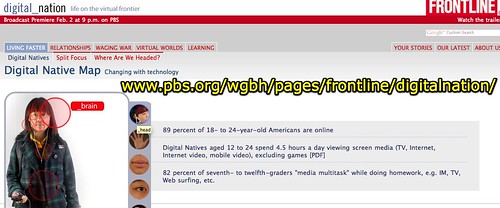
As we were doing it, I wished that I had a good interactive visual that provided facts on who our students are digitally. Today as I was checking my RSS feeds, Wes' blog Moving at the Speed of Creativity linked me to an interactive image full of interesting facts about digital learners.


I keep trying to persuade others that it is really worth their time to develop some form of on-line learning network. RSS is great for those who aren't really ready to talk to others yet and just want to lurk. In the workshop I lead on Friday, one of the teachers remarked that seeing teenagers in a circle texting each other is a lot like watching toddlers when they are at the parallel play stage. For me, watching others get information by searching but not use a digital PGN is the same thing. They are all playing near each other, but no one is playing or learning together. Anyway, thanks to Wes for being a great digital play-date and PBS for another great toy.

Wednesday, January 20, 2010

Learning in CLASSrooms or Communities

I watched an interesting video tonight - it connects to all the pondering I have been doing about how we rethink school to engage our students. Take a look and let me know what you think. What makes the best connection between Collegiate Renewal and technology?

Wednesday, January 13, 2010

Of course we believe collaboration is a good idea – right?

For the last two decades, education journals have been publishing studies that extol the virtues of professional collaboration. In fact, creating a collaborative culture has been identified by some educational researchers as the most important factor in successful school renewal.

Research is clear that, for teachers, working collaboratively:

· inspires the desire to renew professional practices,
· increases instructional competence and confidence,
· makes complex professional tasks more manageable,
· promotes coherence and consistency in instructional practices

Together, teachers have more energy, skills, resources and ideas than an individual teacher and their synergy leads to higher quality planning and instruction.

Thus it is not surprising that we are all familiar with Professional Learning Communities, inquiry teams, PGN’s, teacher learning groups and many other structures designed to promote collaboration. Also, countless sub-days are provided and many detailed facilitation plans are developed so that teachers can work together. These are prevalent in our schools because we want to realize the benefits of collaboration in our division.

However effective these structures and expenditures are, I do wonder if collaboration - an idea with such wide acceptance - requires so many extra efforts and supports. If collaborating is such a good idea, it seems to me that planning and teaching together would occur naturally as a part of our day-to-day work. Does it?

Do we plan instruction together on a regular basis? Is team-teaching common in our schools? Do we develop common assessments with colleagues? Do we invite other teachers into our classrooms as an extra set of eyes and ears to provide feedback on something we can’t take note of while we are teaching? Are our actions evidence of our belief in and commitment to collaboration?

If the answer is yes, let’s share examples of teachers collaborating and the benefits of their work together – to reinforce this as a core element of our professional culture. If the answer is no, let’s find out how to grow a collaborative culture in our division.

Based on what I have read and experienced, I know that time and courage are required for meaningful collaboration. Collaborative planning and instruction take more time and deprivatizing our practice is a professional risk that may be uncomfortable.

To realize the benefits of collaboration we can overcome those two factors:
· Do we already have time built into our work lives that we could use for collaboration?
· Do we have trusted colleagues with whom we can establish a more collaborative professional relationship?

To enhance the quality of our instruction and our students’ learning, we can find the time and the courage required to collaborate.

We believe that collaboration is a good idea – right?


More: Read an “old school” DuFour perspective on collaboration.