Showing posts with label literacy. Show all posts

Tuesday, June 29, 2010

Teacher Librarians and Technology - ISTE 2010 Day 2

I am currently sitting in my first model lesson. It's called Worlds Converge: Fusing Library and Technology in the Classroom. Next year I get to keep working with TLs (Teacher Librarians) in my new role, and one of their major focuses has been technology in the secondary group. They are doing a book club next year with a focus of rethinking libraries in a digital age, and most have developed a virtual presence for their library this year.

A model lesson is a little different than some of the other sessions I have been to so far. 20 of us are on the inside, set up at Macbooks to be "students." I am on the edge so I can blog as I go, but I will be using a clicker to participate. Jenni Swanson Voorhees (K-4 Tech Coordinator) and Angela Smith (Elementary Librarian) are the presenters. Here is the link to the library and to the materials for the lesson. Angela and Jenni teach together, as we are hoping more of our SITLs and Secondary TLs will as we are able to see more connections. Here is the research process they developed collaboratively.

The model lesson is targeted at grade 4, and uses wikis and digital storytelling as its main tool. Like many of the poster sessions and student presentations I have stopped at and not blogged, it helps me to feel secure about the work we are doing. Our Secondary TLs have been working with a variety of digital storytelling tools and many have been partnering with teachers. We still have lots of work to do in helping our teachers learn how to use these tools well to create powerful learning, as you have to use them a while before you start to figure that out.

I enjoyed watching the model lesson, because they explained what they do at each stage and why. They use a book that narrates a student researching (Did Fleming rescue Churchill? : a research puzzle, by James Cross Giblin ; illustrated by Erik Brooks. ISBN: 9780805081831 for my TL friends). The book is a great choice, because the main character reads the urban legend on the website and this leads to a great conversation about authority and veracity. I have used a hoax site for years with secondary students, but it always works well. I have younger students search for the Pacific Northwestern Tree Octopus and the first link is always the hoax site. The nice thing about that one is there appears to be a number of hits on this subject. A classic way to put together several websites in a way students don't have to type them all in is a sharetab. Much simpler to create than a web quest, it is a helpful quick tool for teachers and TLs because it just takes a minute.

The presentation suggests teachers (and their TL support) need to be sure there are both sufficient sites and books when picking a research topic. Good sites for research or books must have:
  • Authority (that means the who the author is needs to be clear)
  • Currency (that means they need a copyright date that is current enough for the type of information)
  • Relevance (alignment to topic and appropriate readability and depth)
  • Usability (easy to navigate and scan, at least 3 ways to get anywhere)
  • Lack of Bias (addresses a research topic without bias, ie is academic instead of persuasive)
The presenters suggested that we all need to learn to read websites, just as we are taught to read a book, as a part of being information literate.

The next section of the presentation focused to teaching students how to take notes from the web, use a custom search in google prepared by a TL (which I would not do at secondary for secondary research), and break jobs among their research group. They suggested brainstorming a list of synonyms to help students search (I also like Google Wonder Wheel, which helps expands searching). They also reminded the group that holding down the CTRL button and pressing the F allows you to search for a specific word or phrase on any website or in any digital document.

One thing the group did not talk about was how to make sure you had a good research question or were conducting a meaningful inquiry. In fact, the topics used as examples were just animals like Pandas and people like Alexander Graham Bell. No one moved to things like: "What can people do help prevent the extinction of Pandas?" which is a low-level inquiry. I think that continues to be a problem in much of the work we do with students, because we never get to the higher level thinking skills.

I liked where the group moved to next. They used a free package of Microsoft software to help students draw their own art using tablet PCs and avoid copyright variations. I don't think it we'd do it that way as art isn't integrated with science much and we don't have tablets. The resulting wikis allowed students to comment on each other's work and see what each other had done without taking a lot of class time for presentations.

I think the more we have TLs and SITLs working together as a team to help teachers, the stronger our work will be. It certainly makes a big difference for teach and student learning every time in happens. Information literacy and 21st Century skills in general continue to be a place where students need stronger skills.

Thursday, March 18, 2010

Reflections on the 21st C Learning Day

It is never easy to look to closely in the mirror if your purpose is to see what is wrong. It is much easier if you are looking into to yourself to try to make things better, and it is even more successful if you have some friends along to help you out. Equipped with my growth mindset, I decided to look closely at the professional learning day Lois and I planned.

At the end of the session on Tuesday, Lois and I looked at the feedback we got from teachers attending. At that point, I was feeling frustrated about how parts of the day had gone. By the time teachers go back to the Gathercole at 2:15, they were clearly tired. They had been listening to each other present since 10:30, and most of the presentations were primarily lectures with visual aides. I realized I needed to do a better job of helping teachers feel comfortable leading others in doing or using more models and examples of student work - it wasn't clear that would be welcome. I was also worried about overlap in some session topics. As I looked out, I saw fatigue reflected back. Lois and I wrapped things up and asked them for their feedback, and I expected them to say it was too much. Mostly, they commented on what worked, what they need to keep learning and what structural changes they'd suggest next time we do this.

I asked for no "good job" style feedback, and our participants mostly gave practical suggestions, and explanations of the impact on them. I got a number of next day or later in the evening feedback around structure of the day. Almost all of it was discussion of how valuable it was to hear what peers were doing, but I also got some good ideas for structure:

"One more idea I wanted to add (as I kept thinking on the drive home) - next time, perhaps people could be surveyed ahead of the session to see what topics they would like to see addressed or presented. This could then help to then help to build the day."

Even teachers would did not attend are thinking about ways which we can keep sharing about technology and learning. One our teacher librarians send me a link to TEDx, a series of TED talk style presentations. As I thought about the day, I realized that I was seeing what I see in a classroom, lots of good learning with some things I'd do differently next time.

After the day was over, a group of six of us got together to add a second mirror - you know, like you do when you want to see your hair in the back (Speaking as middle-aged woman, seeing your backside is not always a great experience.). However, our collective reflection really gave me some good insights this time. Here is what I learned over the two days:

  1. You can't under-estimate the value of just-in-time technical support. We had Jay there for help, but still had many mini-computers that did not work, issues with the Smartboard and some software issues. One thing that I would say is that teachers with greater fluency were much more able to work around the problems (read some interesting comments re the on-going nature of technical problems in the comments about this post)
  2. It is easy to have anxiety about putting your ideas out there. In our group, some of us found it really hard to know our ideas were being 'published' to the world. I think this may be related to another observation I had. Many of the teachers used technology to comment on student work, but a much smaller group encourage student to provide specific, descriptive feedback to others. We teachers struggle with creating and publishing to the world - it's that need for perfection rather than growth. I need to think some more on this one.
  3. I always move things along too quickly, and I did this time even with Lois to slow me down. I need to remember to give others time to reflect. My internship report (last thing a pre-service teacher does to be certified) had one suggestion for improvement - wait time. I need to work more on this.
  4. Teacher's speaking to each other about what they are trying, not what they have perfected, is a really good way to promote reflective practitioners.
  5. We talked to much about the technology and not enough about why we are using it. That happens ever time. Lois and I discussed it and how to avoid it, but it still happened. Dave noticed it within the first 1/2 hour. Hmmmm. . .
I really appreciate all the teachers who stood up to share what they had been trying. We could never have put together a group like this a year ago, and it speaks to how the people in that room continue to be dedicated to a life time of learning. That's one image I am delighted to see reflected back at me and I think it is a critical trait in a great teacher.


Wednesday, March 17, 2010

Literacy: It's not just about reading anymore

I was fortunate to attend an in-service on Literacy in the 21st Century. What made this professional development session different was the audience. The focus was on use of technology, which often means the audience will be individuals with an interest or expertise in technology. Yesterday, half of the audience comprised of language specialists, many of whom also presented.

With four concurrent sessions over three time periods, there were plenty of options for the participants to chose from. It was great to see the use of technology integrated into various areas of instruction.

One of my personal areas of interest are the use of Virtual Classrooms, a piece of our school system's portal. A VC can be used in a variety ways, from web-enhancing a classroom by posting notes, assignments and a calendar of events or to providing online forums for students to post work, provide feedback, work collaboratively, and support each other. It was great to see such a variety of areas leveraging this piece of technology.

Today, I hope to gather a few clips from the various sessions to provide a feel for way technology is being used in Saskatoon schools.

Literacy in the 21st Century: Technology as a Foreign Language

Literacy in the 21st Century is presenting challenges for me as a learner and as a high school English as an additional (EAL) teacher. I readily admit I'm technophobic. (I still rely on my daughter's written list of instructions from 1997 explaining how to program my VCR . . . yes I still use a VCR.) As a participant at the Literacy in the 21st Century workshop on March 16, my reflections are from the voice of the technologically challenged learner.

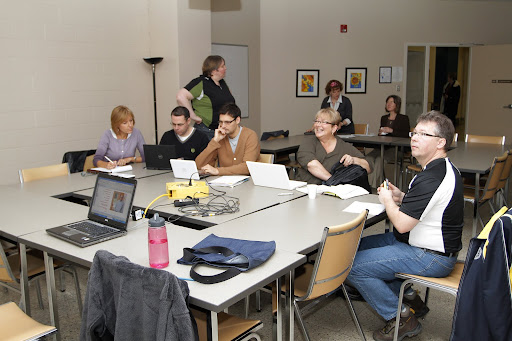
That's me on the left, Arlene Fedorchuk, trying to participate at one of the sessions. Note my trusty pen and paper technology because I can't log in to my computer.

As a technologically challenged learner, I often find learning about new technology overwhelming and energy draining for several reasons. First of all, the language of technology is a foreign language that I am slow in acquiring. Secondly, I struggle with the basics such as logging on or opening sites and I don't know why. Some days I swear leprechauns inhabit my computer and wreck havoc at will. Thirdly, I need to have time to process each step of the application, but because I struggle with technical issues, I'm always a step behind the presenter. I am a bit competitive (I like to think in a healthy way) and I lose focus as I struggle to learn and worry about falling behind. Fourthly, I see the potential in incorporating new technologies in my classroom - I actually get really excited about this - but because when I leave a session, life gets in the way and I don't revisit what I've learned, I'm often left with a sense of failure as a learner and as a teacher who missed an opportunity to offer EAL students alternative pathways to acquiring the English language.


Ironically, however, I was a presenter at yesterday's workshop too. Yes, me - Ms. Technophobe. I presented a session on my EAL students' use of Photostory to share their learning journey in my EAL classroom. I have to say I surprised myself by accepting the invitation to present, especially because I identify myself as illiterate in the area of technological literacy. I realize several factors were part of a process that led me to the place where I had enough confidence to share my learning with my colleagues, which were:

  • stepping out of my comfort zone and taking a risk
  • making the time (uninterrupted time) to spend using and experimenting with Photostory
  • inviting our teacher-librarian to be on hand in my classroom to troubleshoot the technology as together we introduced it to my students and as the students shared their final presentations
  • taking on the role as learner and learning with and from the students
  • trying Photostory again and again with other classes and working out some of the kinks

As a participant at the Literacy in the 21st Century workshop, I came away with an array of feelings and lots to think about. I was amazed at the variety of new technologies shared, and I felt inspired to try some with my students. But I was also overwhelmed by the sheer number of technologies and could feel myself disengaging because of the overload.

Hmmmm . . .

I wonder how students feel about incorporating new technologies into their learning. I've heard the talk that young people are often more technologically savvy than adults. It's true that some EAL students are highly technologically literate and possess the latest technology. But, others arrive with low first language literacy, and have no experience in a school setting, let alone with computers. The common factor among this student group is that each student is an English language learner who needs to acquire both conversational and academic English in order to be successful in high school. As their EAL teacher, the technologies' ability to enhance students' English language acquistion will be what I keep in mind as I decide which new technology to incorporate into our learning environment.